











As we celebrate the 250th anniversary of our nation’s founding, flags seem to wave a little higher, traditions feel a little deeper and it’s only natural to reflect on where we’ve come from. Anniversaries like this have a way of bringing the past into sharper focus. Not just the major moments memorialized in history books, but the atmosphere surrounding them. It makes you wonder…what was an evening in early America actually like? What conversations filled the meeting halls? And what exactly filled the glasses at the very birth of the nation?
 AT THE CENTER OF THE TABLE
For many of us, the image that comes to mind is one of grit and restraint…men in powdered wigs discussing liberty by candlelight, the occasional tankard of ale in hand. But the taverns of early America were often lively hubs of community life, where politics were debated, news traveled quickly, celebrations unfolded and friendships were built. Here, drinking was rarely a solitary act. More often than not, a large bowl of punch was ordered for the table, placed at the center and enjoyed throughout the evening.
Punch was the drink of the time. Not cocktails as we think of them today, carefully measured and individually shaken, but something built for sharing. A mixture of spirits, citrus, sugar, water and spice— prepared in volume and ladled out among friends and strangers alike. Rum was often the spirit of choice thanks to Caribbean trade routes, though brandy and whiskey found their way into the bowl as well.
There’s something appealing about that style of drinking. A large bowl and ladle sitting within reach of the entire table, everyone participating in the ritual of serving and pouring. It feels warmer somehow— no fancy bartender, no carefully curated experience, just conversation, hospitality and the simple act of being together. Perhaps part of the success of those early gatherings wasn’t just the ideas being discussed, but the atmosphere surrounding them.
THE ART OF THE PUNCH BOWL
Punch evolved in countless directions during the colonial era. Some recipes leaned bright and citrus-forward, others richer with spice, tea or wine. Taverns and households often had their own preferred versions, shaped by available ingredients and personal taste. Even among early American taverns, no two bowls were likely to taste exactly the same.
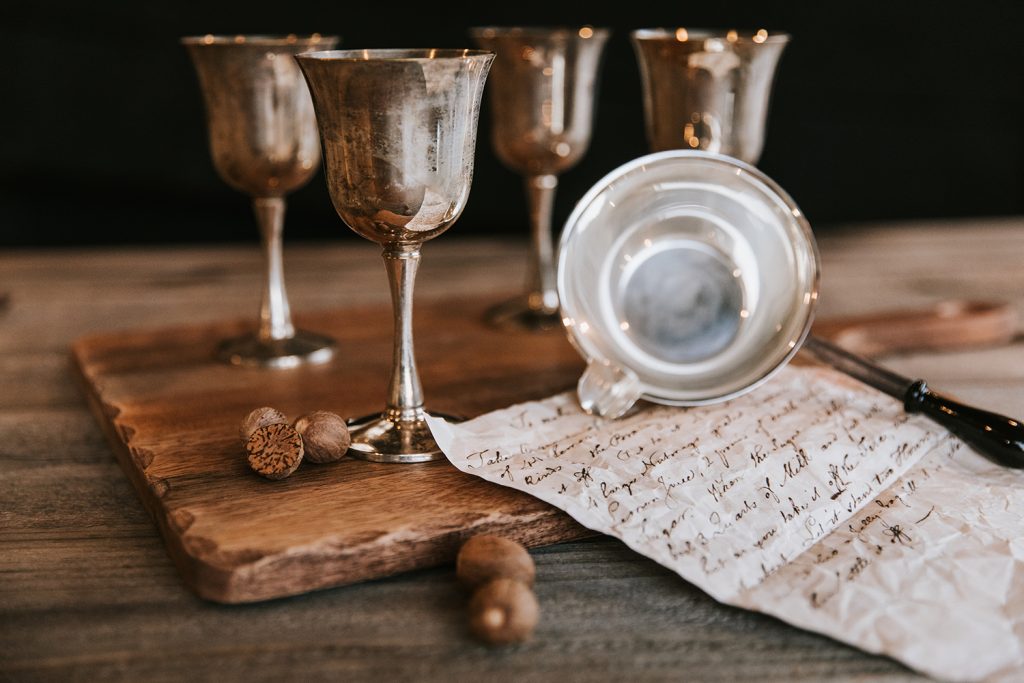
Freshly grated nutmeg became one of the defining finishing touches of colonial punch culture. In an era when imported spices still carried an air of luxury, whole nutmegs and small personal graters became status symbols, often carried by wealthier drinkers in much the same way someone might show off a fancy pocket watch.
A SURPRISINGLY MODERN DRINK
Among the many variations of punch that emerged during that time, one in particular stands apart for both its ingenuity and surprising refinement: milk punch.
At first, it sounds a little strange. Milk and citrus hardly seem like natural companions. But once you learn how it’s made, the drink begins to feel almost modern for its era.

Milk punch begins simply enough: you make the cocktail or punch much as you normally would. But instead of pouring it into a glass to enjoy, it’s slowly poured into milk instead. As the citrus and alcohol meet the milk, it begins curdling almost immediately, and the entire thing looks about as unappealing as you might expect. But as the curds develop, they begin softening many of the harsher edges of the drink itself.
After resting for a bit, the straining begins. Cheesecloth would have been a common choice then, though today most people reach for coffee filters instead. Once strained, what’s left behind is a remarkably clear and smooth cocktail that could last for weeks, even months, without spoiling. In a time before refrigeration, that wasn’t just convenient…it was ingenious.
It’s almost difficult to believe techniques like this existed centuries ago in taverns and home kitchens long before modern cocktail bars began talking about clarification, texture and balance as though they were new concepts.
SOMETHING WORTH BORROWING
And maybe that’s what feels most interesting about these early drinks. The idea of “mixology” wasn’t new—it simply looked different then. Less about precision, tools and presentation, more about intuition, hospitality and practicality.
A process that required a little time and rewarded you for it. A table meant for gathering. A drink meant to be shared.
And maybe there is something worth borrowing from that. Because long before we were carefully measuring ounces into a shaker, our forefathers were gathering around a table, raising a glass from the same bowl and toasting to something larger than the drink itself.
 Benjamin Franklin’s Clarified Milk Punch
8–12 servings, depending on pour size
Benjamin Franklin’s clarified milk punch recipe survived through a letter he wrote while living in France during the late 1700s, and images of the original document can still be found online today. Nearly any cocktail can be milk washed and countless clarified milk punch recipes are available online, making it a fun technique to experiment with far beyond these early punch recipes.
Benjamin Franklin’s Original Recipe (in his words)
“Take 24 ounces of brandy, and the rinds of 5-6 lemons pared very thin; Steep the rinds in the brandy 24 hours; then strain it off. Put to it 16 oz of water, ½ a nutmeg grated, 8 oz of lemon juice, 4 oz of double refined sugar. When the sugar is dissolved, boil 12 oz of milk and put to the rest hot as you take it off the fire, and stir it about. Let it stand two hours; then run it thro’ a jelly-bag till it is clear; then bottle it off.”
Erin’s notes: I took the liberty of adjusting the volumes; the instructions, however, remain Franklin’s own words.
INGREDIENTS
• 24 ounces brandy
• Peels of 5–6 lemons, pared thin
• 16 ounces water
• ½ grated nutmeg
• 8 ounces fresh lemon juice
• 4 ounces sugar
• 12 ounces whole milk
STEPS
1. Infuse the lemon peels in the brandy for 24 hours, then strain.
2. Combine with water, lemon juice, sugar and grated nutmeg until the sugar dissolves.
3. Slowly pour the mixture into hot milk and stir gently as it curdles.
4. Let rest for two hours before straining carefully through cheesecloth or coffee filters until clear.
5. Bottle and serve chilled.
 Fish House Punch
10–12 servings, depending on pour size
INGREDIENTS
• 4 lemons, peeled
• 1¼ cups demerara sugar
• 8 ounces boiling water
• 375 milliliters Jamaican rum
• 6 ounces V.S.O.P Cognac
• 6 ounces peach brandy
• 6 cups (48 ounces) water
• 8 ounces fresh lemon juice
• Fresh grated nutmeg, for garnish
STEPS
1. In a large bowl, muddle the lemon peels and demerara sugar together to create an oleo saccharum (Latin for “oil sugar”), a traditional punch-making technique that draws the fragrant oils from the peels into the sugar.
2. Let the mixture rest for 30 minutes to several hours.
3. Add boiling water and stir until the sugar has dissolved, then allow the mixture to cool completely.
4. Add the rum, Cognac, peach brandy, 6 cups of water and fresh lemon juice, stirring well to combine.
5. Serve in a punch bowl over a large block of ice and garnish generously with freshly grated nutmeg.
Erin’s Notes: Founded in 1732 by a group of prominent Philadelphia Quakers, the Schuylkill Fishing Company—often called the Colony in Schuylkill—was a private fishing and social club along the Schuylkill River. The members gathered at a riverside clubhouse known as the Fish House, where the drink now known as Fish House Punch became closely tied to the club and its traditions. In 1782, the group renamed itself the State in Schuylkill, and despite relocating over the centuries, the club still exists today as one of the oldest continuously operating social clubs in America.
By Erin Estill
Photos By Shayli Anne Photography
RELATED: Mixing Up the Scene








Leave a Reply