












 THE CRAFT BEHIND THE MUG
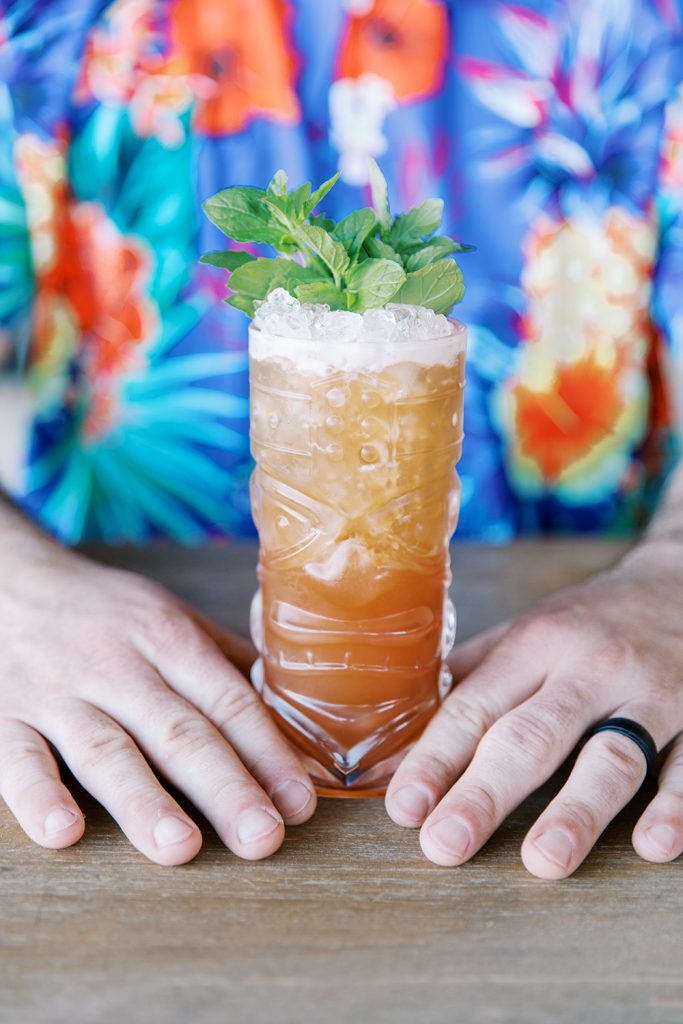
Few cocktail traditions are as instantly recognizable— or as widely misunderstood—as tiki. Ceramic mugs, flaming garnishes, paper umbrellas and aloha shirts have long shaped its image. For many people, that image is where the story begins and ends: colorful drinks, a bit of spectacle and the assumption that what arrives in the glass will be overly sweet. Yet behind the surface lies something far more complex: cocktails with remarkable precision and carefully chosen blends of rum that often demand as much thought as any classic stirred drink.
As summer approaches, these drinks naturally feel at home. Bright citrus, crushed ice and novelty glassware seem made for sunny days. There is something immediately inviting about a drink that arrives looking unapologetically cheerful. Yet the appeal extends well beyond appearance. To really understand and appreciate the tradition, it helps to look past the décor and into the culture, craft and spirit that shaped it.
 THE BIRTH OF ESCAPISM IN A GLASS
Tiki culture emerged in the United States during the 1930s, in the depths of the Great Depression, when escapism held some real appeal. Travel to distant islands was out of reach for most Americans, but for an evening, that fantasy could be found much closer to home. Step inside and suddenly the world changed: bamboo walls, fishing nets, puffer fish lamps, carved wood, shells, dim lighting and the feeling of being transported somewhere far away.
Much of the tradition traces back to two figures: Donn Beach, born Ernest Raymond Beaumont Gantt and Trader Vic, born Victor Bergeron.
In 1934, Don the Beachcomber opened in Hollywood and introduced a style of rum cocktail unlike anything most Americans had experienced. Inspired by his travels through the Caribbean and South Pacific, the drinks were layered with fresh citrus, syrups, baking spice and often multiple rums. Coming just after Prohibition, when many cocktails were simple three-ingredient formulas, Beach’s recipes sometimes stretched to 10 or 12 ingredients, making them unusually elaborate for the era.
Beach guarded his recipes carefully. Ingredients were written in code, bottles labeled with numbers and only a trusted few knew what each drink contained. The secrecy became part of the appeal, and the small bar quickly became a gathering place for Hollywood elite and regular patrons alike.
Soon after, Trader Vic developed his own interpretation of the style. His drinks were slightly more polished and balanced than Beach’s, and he helped define some of the drinks most closely associated with tiki’s golden era, including the Mai Tai. His vision extended beyond the glass or a single bar. He began expanding Trader Vic’s locations across the United States and eventually around the world, helping the style reach far beyond California. Today, only a handful of Trader Vic’s locations remain in the United States, but the influence of that era still lives on behind modern bars.
 THE GREAT RUM MISUNDERSTANDING
If this genre has been misunderstood, rum perhaps even more so.

For many people, rum carries the reputation of being sugary or one-dimensional, often because the bottles they have encountered were inexpensive mixing rums that are exactly that. In reality, rum is widely considered the most diverse spirit in the world.
By definition, rum is a distilled alcohol made from fermented sugarcane products—molasses, sugarcane juice or syrup. With so few production requirements comes remarkable variation. A grassy, vegetal rhum from Martinique tastes entirely different from the molasses-rich rums of Jamaica or the lighter Spanish style rums associated with Puerto Rico and Cuba. Methods of fermentation, distillation and aging expand the flavor spectrum even further.
Each expression of rum contributes something different—funk and aroma, body or brightness, structure or lift, sometimes spice, fruit or a lingering finish. A single cocktail may combine multiple styles to create its intended flavor and character. Understanding rum in this way begins to reveal the real craft behind these drinks: they are far from overly sweet punch, but instead carefully engineered compositions where each bottle plays a distinct role.
 A FRESH LOOK AT RUM
To explore tiki is to discover rum—not as a single flavor, but as a global category. It is to appreciate balance and layering, and to recognize that beneath the mugs and garnish is a style of cocktail with remarkable precision. These drinks remind us that more than one thing can be true at once: a drink can be whimsical, even a little silly and still sophisticated in the glass.
So, this summer I encourage you to find yourself a floral shirt—or don’t—and take a fresh look at rum. Pick up a bottle you may not have tried before, mix up a few recipes and you may discover what generations of bartenders have understood all along: some of the most interesting drinks begin with rum.
A Quick Guide to Rum
Lightly Aged Rum
Clean and subtle, often from Puerto Rico or Cuba
Don Q, Bacardi
Moderately Aged Rum
Oak-aged with vanilla, spice and structure
Mount Gay from Barbados, Appleton Estate from Jamaica
Blended Rum
Combining distillates for balance and depth
Plantation, El Dorado
Black Rum
Fuller-bodied, darker in color, often with molasses richness and baking spice
Myers’s, Goslings
Jamaican Pot Still Rum
Bold, aromatic and fruit-forward
Smith & Cross
Agricole Rum
Made from fresh cane juice in Martinique, often grassy and herbal
Rhum J.M.
Overproof Rum
Higher proof, often used sparingly for aroma and lift
Wray & Nephew, Lemon Hart
*For anyone wanting to explore rum a little further, I highly recommend Smuggler’s Cove by Martin and Rebecca Cate.
Mai Tai
Ingredients
- 1 ounce Jamaican rum
- 1 ounce Moderately Aged Rum
- ½ ounce orange curaçao
- ½ ounce orgeat syrup
- ¾ ounce fresh lime juice
- Garnish: fresh mint
Steps
- Add all ingredients to a shaker with crushed ice and shake until well chilled.
- Pour unstrained into a double old-fashioned glass and top with additional ice if needed.
- Garnish with a generous handful of fresh mint.
*Erin’s notes: Few cocktails are more synonymous with tiki than the Mai Tai. The rum used in the original recipe disappeared decades ago, so modern versions often rely on blends—typically an aged Jamaican rum paired with something funkier to build depth.
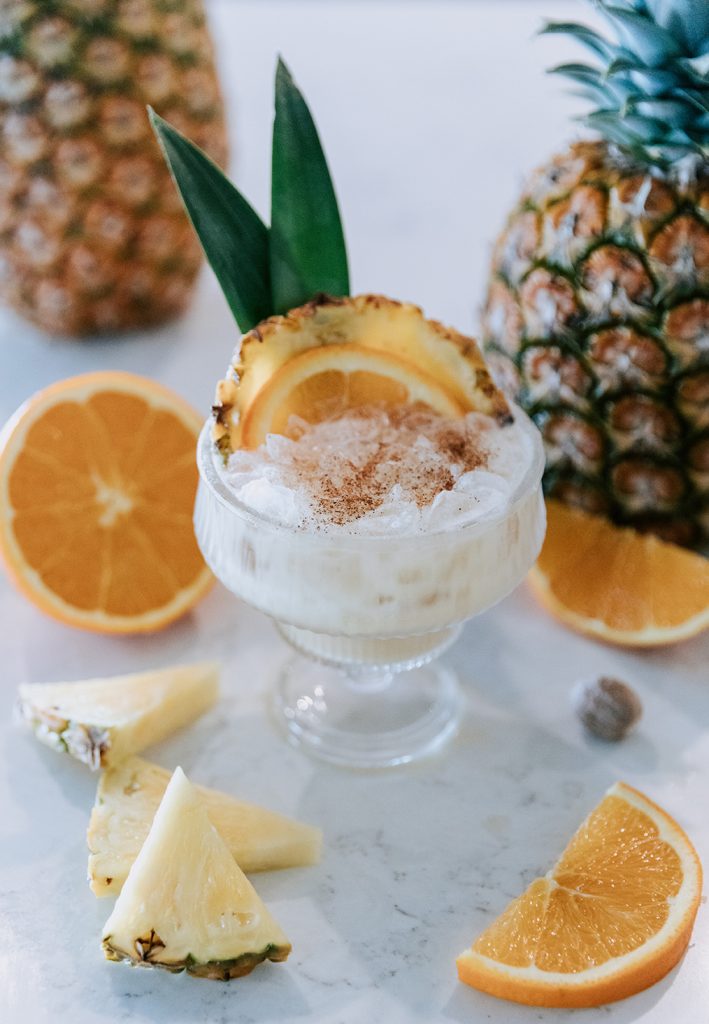
Painkiller
Ingredients
- 2 ounces Pusser’s Rum
- 4 ounces pineapple juice
- 1 ounce orange juice
- 1 ounce Coco Lopez
- Garnish: pineapple wedge and nutmeg
Steps
- Shake briefly with cubed ice to chill and combine.
- Then strain into a hurricane glass or snifter filled with crushed ice.
- Garnish with freshly grated nutmeg and pineapple.
*Erin’s notes: More modern than many classic tiki drinks, the Painkiller originated at Soggy Dollar Bar, where visitors famously swim ashore to order one. For a nonalcoholic version, simply leave out the rum or use a nonalcoholic alternative, though technically the name is trademarked by Pusser’s Rum, so you may need to call it something else.
Don Tiki
Ingredients
- 5 ounce blended scotch
- ½ ounce Disaronno
- 1 ¼ ounces Coco Lopez
- 1 ounce lime juice
- ½ ounce simple syrup
- 6 large Thai basil leaves (Thai basil is almost always available at H-E-B in town.)
Steps
- Add all ingredients to a blender with 1 cup of ice and blend until smooth and evenly
- Pour into your glass of choice.
*For an alcohol-free version, substitute 2 ounces of strong black tea for the scotch and ½ ounce of orgeat syrup for the Disaronno.
*Erin’s notes: I know…where’s the rum? Tiki while heavily focused on rum can certainly extend beyond it. I was living in Hawaii when I first encountered the Don Tiki. I read this list of ingredients and thought no way. But my husband ordered it, curious how scotch would work in a blended drink. And as it turned out, it was amazing. It remains one of my favorite cocktails to date.
Planter’s Punch
Ingredients
- 3 ounces blended aged rum
- ½ ounce St. Elizabeth Allspice Dram
- 1 ounce fresh lime juice
- ¾ ounce demerara syrup
- 2 dashes Angostura bitters
- Garnish: fresh mint
Steps
- Combine all ingredients into a shaker with crushed ice and briefly shake.
- Open pour into a Collins or highball glass.
- Garnish with a sprig of mint.
Zombie
Ingredients
- 1 ½ ounces Jamaican rum
- 1 ½ ounces Puerto Rican rum
- 1 ounce overproof black rum
- ½ ounce Falernum
- ¾ ounce lime juice
- ¼ ounce grapefruit juice
- ¼ ounces cinnamon syrup
- 1 teaspoon grenadine
- 1 dash Angostura Bitters
- 6 drops Pernod or Absinthe
- Garnish: fresh mint
Steps
- Combine all ingredients into a blender. Then add 6 ounces of crushed ice. Blend at high speed for 5 seconds.
- Pour the contents into a tall glass or Tiki mug and add additional crushed ice to fill, if necessary.
- Garnish with a mint sprig.
*Erin’s notes: Created at Don the Beachcomber in 1934, the Zombie is one of tiki’s defining classics and famously its strongest. Think of it as tiki’s Long Island Iced Tea. While it can be a bit much for one person, its generous pour makes it ideal for splitting into two cups and sharing with a friend.
By Erin Estill
Photos By Shayli Anne Photography









Leave a Reply